Curlew

Introduction
Survey data have documented the decline in breeding Curlew populations across Britain & Ireland, prompting research and conservation efforts to support the species.
After decades of decline, particularly in farmland, Curlew are now a scarce breeding species in lowland areas, with strongholds in some upland landscapes. The bird's evocative bubbling call, echoing above the heather moorlands and upland-edge grazing, is a well-loved feature indicating the health of these important habitats.
In winter the population moves to the coasts and its adjacent farmland, where it is joined by large numbers of migrants from Fennoscandia. The Wetland Bird Survey records the two most important sites for Curlew as The Wash and Morecambe Bay, demonstrating its wide winter distribution.
- Our Trends Explorer gives you the latest insight into how this species' population is changing.
Key Stats


Identification
ID Videos
This section features BTO training videos headlining this species, or featuring it as a potential confusion species.
Curlew and Whimbrel
Songs and Calls
Song:
Call:
Alarm call:
Status and Trends
Conservation Status
Population Change
CBC and BBS reveal a long-term decline, despite an initial increase that lasted until the mid 1970s. At WBS/WBBS sites, in contrast, the downturn did not begin until the late 1990s, suggesting there may have been some movement during the 1980s and 1990s from farmland onto wetter sites. Surveys of lowland wet grassland, however, showed Curlew losses of almost 39% between 1982 and 2002, more specifically of 34% in England and 75% in Wales (Wilson et al. 2004, 2005a). Breeding Curlews had declined significantly between 1980 and 2002 in six of 13 upland study areas across Britain (Sim et al. 2005). A 2006 survey in Wales highlighted the rapid decline of the species across all habitats, with low breeding success as a plausible mechanism (Johnstone et al. 2007). In Northern Ireland, the breeding population had shrunk to just 526 (252-783) pairs by 2013, representing a decrease of around 82% since 1987, with the distribution becoming increasingly fragmented (Colhoun et al. 2015). Through its UK breeding decline, the species moved from amber to being red listed in the latest review (Eaton et al. 2015).
BBS trends show continued declines since 1995 throughout the UK, with the strongest declines in Scotland and in Wales. The BBS map of change in relative density between 1994-96 and 2007-09 indicates that decrease has been concentrated into southwestern Scotland, Wales and parts of northern England, with increases in a few regions of Cumbria and the Pennines. Wintering Curlew abundance showed a shallow long-term increase to around 2000, but has since declined (WeBS: Frost et al. 2020). There has been a decline across Europe since 1980 (PECBMS: PECBMS 2020a>). Through its Near Threatened global status and the international importance of the declining UK populations, and bearing in mind the history of extinction and declines among its close relatives (Pearce-Higgins et al. 2017), Curlew has been identified by one paper as 'the most pressing bird conservation priority in the UK' (Brown et al. 2015).
Distribution
Although Curlews still breed in many areas of northern and western Britain, particularly uplands and marginal areas, but the range is significantly smaller than it used to be and abundance has decreased almost everywhere. Further south and east there are isolated small populations, such as in the Brecks of East Anglia. Losses in Ireland have been extreme. In winter, UK breeding Curlews move to the coast and adjacent farmland, where they are joined by large numbers of migrants from Fennoscandia. Highest densities are on the major estuaries, the Northern Isles and in western Ireland.
Occupied 10-km squares in UK
2007/08–10/11
or view it on Bird Atlas Mapstore.
2008–11
or view it on Bird Atlas Mapstore.
European Distribution Map
Distribution Change
The loss of breeding Curlews from most of Ireland and parts of western Britain over the last 40 years is a major conservation issue. Since the 1968–72 Breeding Atlas the range has contracted by 78% in Ireland and 17% in Britain. In Ireland losses have occurred mostly within the last 20 years.
Change in occupied 10-km squares in the UK
from 1981–84 to 2007–11
or view it on Bird Atlas Mapstore.
from 1968–72 to 2008–11
or view it on Bird Atlas Mapstore.
Seasonality
Curlews are recorded throughout the year.
Weekly pattern of occurrence
The graph shows when the species is present in the UK, with taller bars indicating a higher likelihood of encountering the species in appropriate regions and habitats.

Habitats
Breeding season habitats
Relative frequency by habitat
The graph shows the habitats occupied in the breeding season, with the most utilised habitats shown at the top. Bars of similar size indicate the species is equally likely to be recorded in those habitats.

Movement
Britain & Ireland movement
Foreign locations of birds ringed or recovered in Britain & Ireland
Dots show the foreign destinations of birds ringed in Britain & Ireland, and the origins of birds ringed overseas that were subsequently recaptured, resighted or found dead in Britain & Ireland. Dot colours indicate the time of year that the species was present at the location.
- Winter (Nov-Feb)
- Spring (Mar-Apr)
- Summer (May-Jul)
- Autumn (Aug-Oct)

European movements
EuroBirdPortal uses birdwatcher's records, such as those logged in BirdTrack to map the flows of birds as they arrive and depart Europe. See maps for this species here.
The Eurasian-African Migration Atlas shows movements of individual birds ringed or recovered in Europe. See maps for this species here.
Biology
Productivity and Nesting
Nesting timing
Egg measurements
Clutch Size
Survival and Longevity
Survival is shown as the proportion of birds surviving from one year to the next and is derived from bird ringing data. It can also be used to estimate how long birds typically live.
View number ringed each year in the Online Ringing Report.
Lifespan
Survival of adults
Survival of juveniles
Biometrics
Wing length and body weights are from live birds (source).
Wing length
Body weight
Ring Size
Classification, names and codes
Classification and Codes
- Order: Charadriiformes
- Family: Scolopacidae
- Scientific name: Numenius arquata
- Authority: Linnaeus, 1758
- BTO 2-letter code: CU
- BTO 5-letter code: CURLE
- Euring code number: 5410
Alternate species names
- Catalan: becut eurasiàtic
- Czech: koliha velká
- Danish: Storspove
- Dutch: Wulp
- Estonian: suurkoovitaja
- Finnish: kuovi
- French: Courlis cendré
- Gaelic: Guilbneach
- German: Großer Brachvogel
- Hungarian: nagy póling
- Icelandic: Fjöruspói
- Irish: Crotach
- Italian: Chiurlo maggiore
- Latvian: (kuitala), kluite
- Lithuanian: didžioji kuolinga
- Norwegian: Storspove
- Polish: kulik wielki
- Portuguese: maçarico-real
- Slovak: hvizdák velký
- Slovenian: veliki škurh
- Spanish: Zarapito real
- Swedish: storspov
- Welsh: Gylfinir
- English folkname(s): Whaup
Research
Causes of Change and Solutions
Causes of change
There is good evidence that loss of habitat is the main cause of decline of Curlew. Decline of the species on grassland is likely to be correlated to draining of fields, whilst predation is likely to be important at a site level. The decline of Curlew recorded by WBS/WBBS may be related to other causes, such as land reclamation but data are not available. The conservation of Curlew is likely to benefit from wader-friendly management of land, including restoration of ditches, wet features within fields and heterogeneous vegetation. Further studies should concentrate on investigating the direct link between Curlew abundance and management of coastal areas, including the outcome of displacement of individuals from feeding sites on mudflats.
Further information on causes of change
Analysis investigating potential drivers of breeding abundance and population change across Britain, using BBS data from 1995-99 and 2007-11, found support for the negative effects of intensive agriculture, forestry, increased predation and climate warming on Curlew abundance and population trends, and suggested that site protection, measures to reduce generalist predator abundance and wider improvements to breeding habitat may be required to reverse declines (Franks et al. 2017).
Habitat change is the main cause of decline that has been identified by other studies, in particular drainage of grassland and management changes in the uplands. Loss of peatland, drainage of wetlands and afforestation have been suggested as causes of decline in Ireland (Partridge & Smith 1992). In a Northern Irish study, the preferred habitat for Curlew was bog/mire and unimproved grassland, with areas of standing water, whilst the species was less abundant than expected on improved grassland, upland rough grassland and arable land (Henderson et al. 2002). In the Welsh uplands, abundance was highest in moorland edge habitats with both moorland and improved grassland, and success was associated with mire habitats with Trichophorum germanicum (Johnstone et al. 2017). In a study of GPS tracked birds in Scotland, two birds travelled at night to improved grassland up to 1.6km away from the nest site, presumably to forage, but a third bird stayed close to the nest and apparently did not use improved grassland, suggesting that habitat usage may be variable (Ewing et al. 2017).
Amar et al. (2011) showed that, between 1980-93 and 2000-02, Curlews had declined most in heather-dominated upland sites and least in bog-dominated ones. An earlier study had found that Curlew abundance was higher on moorland managed for grouse shooting than on other moorland, probably mediated by increased predator control on grouse moors (Tharme et al. 2001): these results led to the suggestion that reduction in grouse moor, managed to favour heather regrowth and to control predators, might be behind the decline of wader populations in the uplands (Baines et al. 2008, Fletcher et al. 2010), but Amar et al. (2011) found no correlation between grouse moor and Curlew population change. Recent studies of upland moorland management have suggested that vegetation heterogeneity and structural complexity are important for Curlews (Buchanan et al. 2017) and abundance increased in a study in Cumbria when a greater area of vegetation was cut (Douglas et al.2017).
Studies of the impact of predators on Curlew abundance and breeding success have reached opposing conclusions, suggesting some case-by-case relevance of predators to local Curlew populations. A study on upland waders found no negative spatial or temporal relationship between Ravens and Curlew abundance, using surveys from 1980 and 1993 repeated in 2000 and 2002 (Amar et al. 2010b). In contrast, control of foxes and crows on two moorland and marginal farmland plots in Northumberland increased breeding success from 15% to 50%, with an increase of 14% per annum in breeding numbers after a three-year lag (Fletcher et al. 2010), and a study covering four upland regions found a positive correlation between predator control and Curlew abundance (Buchanan et al. 2017). Predation of eggs was identified as the primary proximate cause of failure in up to 97% of nests in a study during 1993-95 in Northern Ireland (Grant et al. 1999), and a study in Breckland in 2017-18 also recorded low and unsustainable nest survival rates, mainly due to predation by foxes (Zielonka et al. 2019). Increases in Curlew numbers at Langholm Moor between 2008 and 2017 were also attributed to predator control (Ludwig et al. 2019). A survey of 18 estates in northern England and south-east Scotland also concluded that predator control had positive effects on Curlew abundance, but found that these effects saturate at a relatively low level of control above which there were few benefits (Littlewood et al. 2019). On Shetland however, no evidence was found of a relationship between Curlew and predator abundance over 40 farms participating in the Agri-Environment Scheme (AES) (van der Wal & Palmer 2008). In Sweden, Curlew nest predation rates were higher in mixed farm landscapes than in arable ones (Berg 1992). A study on mixed farmland in Perthshire, however, crop type changes were identified as a likely contributor to declines over 1990-2015, though mammalian predators were not monitored (Bell & Calladine 2017).
Curlews are expected to respond adversely to climate change (Renwick et al. 2012, Douglas et al. 2014). It has been suggested that Curlews and other breeding waders are becoming increasingly restricted to sites managed as nature reserve or under the higher tiers of AES (Ausden & Hirons 2002, Wilson et al. 2004, 2007, O'Brien & Wilson 2011). Some authors have found potential benefits of AES for Curlews and other waders, e.g. where stocking densities have been reduced (van der Wal & Palmer 2008), but others have found that the benefits of AES are not always apparent or do not apply to all wader species (O'Brien & Wilson 2011, Smart et al. 2013). Nevertheless, conservation of Curlew is likely to benefit from wader-friendly management of land, including restoration of ditches, of wet features within fields and of vegetation diversity.
An expert assessment of global threats to Curlew and its near relatives (Pearce-Higgins et al. 2017) identified agricultural and land-use changes (crops, livestock and plantations), dams, drainage, invasive species and climate change as the threats most likely to have had the greatest breeding season impact on population trends within the East Atlantic flyway (which includes the British Isles). Outside the breeding season, they considered that the main threats came from agriculture (crops), aquaculture and fishing, renewable energy, transport, disturbance, drainage and climate change.
A study of colour-ringed birds wintering in south-west England suggested that apparent survival was highest during winter, and hence the main threats to this wintering population appeared to be during the breeding season or on migration (Robinson et al. 2020)
Information about conservation actions
The main cause of the decline is believed to relate to habitat changes at breeding sites (see Causes of Change section, above), and therefore improvements to breeding habitat may be required to halt and reverse declines. The conservation of Curlew at a local scale is likely to benefit from wader-friendly management of land, including restoration of ditches, wet features within fields and heterogeneous vegetation, and delaying cutting of fields. Predation may be important at some sites (see Causes of Change section) and therefore measures to control and reduce generalist predator abundance may also benefit the species (Franks et al. 2017). However, a survey of 18 estates in northern England and south-east Scotland found that the positive effects of predator control on Curlew abundance saturate at a relatively low level of control above which there were few benefits (Littlewood et al. 2019). The same study did not find any benefits to waders resulting from heather burning.
In Ireland, a participatory approach involving communication and involvement of all stakeholders is being used to attempt to reverse the decline; whilst early results appear to be encouraging, ongoing stakeholder collaboration and government support may be needed to maintain a viable breeding population (Young et al. 2020).
At a national scale, the provision of options to enable local habitat management actions may help increase the take up of habitat management options to benefit Curlews. A Swedish study found that breeding populations increased most at sites with the greatest proportion of grassland suggesting that this habitat if important for Curlews (Berg 1994). A study in Breckland found that Curlew selected experimentally physically disturbed grassland plots rather than undisturbed grassland for nesting, and suggested that undertaking ground disturbance, e.g. through shallow-cultivating, could be used to attract Curlew to safer areas to nest, such as inside anti-predator fences (Zielonka et al. 2019). Habitat management in Wales to provide a mosaic of short and taller moorland vegetation, new pools and enclosed grassland was successful in increasing breeding populations but the effect was short-lived (Fisher & Walker 2015).
Publications (20)
Power source, data retrieval method, and attachment type affect success of dorsally mounted tracking tag deployments in 37 species of shorebirds
Author: Weiser, E.L., Lanctot, R.B., Ruthrauff, D.R., Saalfeld, S.T., Tibbitts, T.L., Abad-Gómez, J.M., Aldabe, J., Bosi de Almeida, J., Alves, J.A., Anderson, G.Q.A., Battley, P.F., Belting, H., Bêty, J., Bianchini, K., Bishop, M.A., Bom, R.A., Bowgen, K., Brown, G.S., Brown, S.C., Bugoni, L., Burton, N.H.K., Bybee, D.R., Carneiro, C., Castresana, G., Chan, Y.-C., Choi, C.-Y., Christie, K.S., Clark, N.A., Conklin, J.R., Cruz-López, M., Dinsmore, S.J., Dodd, S.G., Douglas, D.C., Eberhart-Hertel, L.J., English, W.B., Ewing, H.T., Faria, F.A., Franks, S.E., Fuller, R.A., Gill Jr, R.E., Giroux, M.-A., Gratto-Trevor, C.L., Green, D.J., Green, R.E., Green, R.M.W., Gunnarsson, T.G., Gutiérrez, J.S., Harrison, A.-L., Hartman, C.A., Hassell, C.J., Hoepfner, S.A., Hooijmeijer, J.C.E.W., Johnson, J.A., Johnson, O.W., Kempenaers, B., Klaassen, M., Kok, E.M.A., Krietsch, J., Küpper, C., Kwarteng, A.Y., Kw
Published: 2025
Tracking studies, where individual devices are fitted to birds to follow their movements, are becoming increasingly common in ornithology. This paper uses previous research tracking waders to evalutate how various factors, including tag attachment type and power source, affect the likelihood that a study will meet its goals, and provides guidelines for selecting a tracking technique to optimise the chances of success.
04.12.25
Papers

GPS-tracking breeding Curlew in the Yorkshire Dales: breeding success, home range size, and habitat use
Author: Bowgen, K., Jarrett, D., Franks, S., Langlois Lopez, S., Clark, N., Clark, J. & Noyes, P.
Published: 2025
This study uses GPS tags, fitted to adult Curlews in the Yorkshire Dales National Park, to infer nest and brood locations and breeding outcomes from movement patterns of the tagged birds.
10.09.25
BTO Research Reports

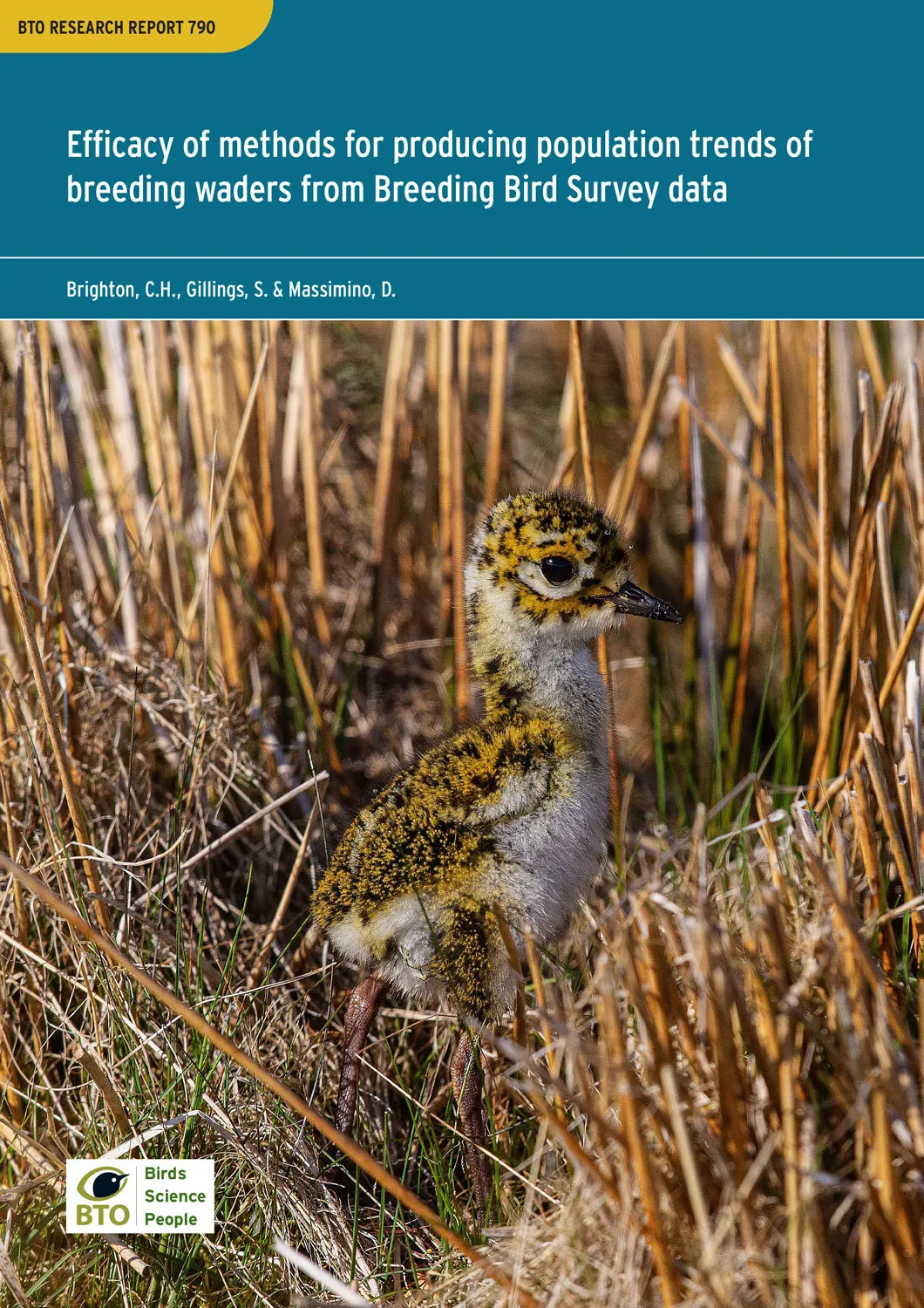
Efficacy of methods for producing population trends of breeding waders from Breeding Bird Survey data
Author: Brighton, C.H., Gillings, S. & Massimino, D.
Published: 2025
This report investigates the efficacy of methods for producing population trends from BTO/JNCC/RSPB Breeding Bird Survey data for six breeding wader species in the UK. It examines the effects of increasing the count threshold on the population trends for these six species, and also explores the effects of different geographic exclusion rules on the population trend of Golden Plover. Overall, it aims to test for any potential biases in the current trends, and in doing so, determines whether we can create a better approach which provides the most robust data for wader conservation moving forwards.
23.06.25
BTO Research Reports
Landscape context influences efficacy of protected areas and agri-environment scheme delivery for breeding waders
Author: Hawkes, R.W., Mason, L.R., Conway, G.J., Siriwardena, G.M., Grice, P.V., Cole, A.J. & Peach, W.J.
Published: 2025
16.04.25
Papers

A review of Curlew headstarting projects in Europe
Author: Ewing, H. Bowgen, K.M., Burton, N.H.K., Saunders, R., Perkins, A., Gajko, A., O’Donoghue, B., Kala, B., Kerperin, C., Kelley, C., Heward, C.J., Krupiński, D., Nijs, G., Weber, H., Düttmann, H., Kruckenberg, H., Deiting, J., Thiess, L., Szajda, M., Maluśkiewicz, M., Boschert, M., Obłoza, P., Tüllinghoff, R., Kelly, S.B.A., Grigg, T. & Franks, S.E.
Published: 2025
Breeding waders are among the most threatened of European bird species and the focus of a suite of conservation interventions, such as the improvement of grassland nesting habitats, and the protection of nests and chicks from predators and destruction by agricultural activities. Headstarting is a relatively novel technique in breeding wader conservation, where eggs are removed from the wild and reared in carefully controlled environments. It aims to bypass the threats individuals encounter during vulnerable early life stages in the wild. Headstarting differs from more traditional forms of captive rearing, in that individuals only remain in captivity for a small part of their life cycle (generally egg and hatchling stages) and are released once at a less vulnerable stage to provide a quick, artificial boost to the breeding productivity of a wild population.
01.04.25
Papers

Factors influencing nest site selection in a rapidly declining shorebird, the Eurasian curlew
Author: Rivers, E.M., Short, M.J., Page, A., Potts, P.M., Hodder, K., Hoodless, A., Robinson, R. & Stillman, R.
Published: 2024
The Curlew is Britain’s largest wader; it is also one of its most threatened. Previous BTO research has shown that this is largely due to the number of chicks fledged that are able to survive to reach breeding age. In this case, if we are to help improve the situation for the Curlew, then we need to understand the factors that influence their breeding success.
30.12.24
Papers

Watching Out for Waders: The Working for Waders Nest Camera Project
Author: Noyes, P., Laurie, P., Wetherhill, A. & Wilson, M.
Published: 2024
This report presents the results of a trial involving the use of trail cameras by land managers and other wader conservation stakeholders to monitor the outcome of wader nesting attempts. It presents the results of the trial and assesses the potential for the project to improve wader conservation knowledge and management.
04.10.24
BTO Research Reports

Contrasting habitat use between and within Bar-tailed Godwit and Curlew wintering on the Wash, England
Author: Pell, R.J., Clark, J.A. & Robinson, R.A.
Published: 2023
Ongoing declines have been reported for many of our wader species, and there is an urgent need to both understand the reasons for these declines and assess the effectiveness of any associated conservation action. Intertidal habitats are often well-used by waders outside the breeding season, but some species also make use of other adjacent habitats during this period, including agricultural fields. Understanding the importance of these non-tidal habitats for waders is crucial, especially as such land is rarely included within the protected areas designated for these species. This study investigates the use of non-tidal habitats bordering The Wash – an estuary in eastern England – by Curlew and Bar-tailed Godwit, species which are designated as ‘Near Threatened’ by the IUCN. Information on the winter-feeding distribution of the two species was collated from resightings of individually colour-marked birds, initially caught and ringed at sites around The Wash by the Wash Wader Research Group. The sex of individual birds was determined from measurements taken in the field, and this provided an opportunity to determine if males and females differed in their use of the available habitats. The resightings revealed that Bar-tailed Godwits were only seen on intertidal habitats and none were observed feeding inland. In contrast, colour-marked Curlews were regularly observed feeding on agricultural fields, the colour-marks revealing that the majority of individuals were feeding on both fields and mud flats. Importantly, those Curlews seen feeding in fields were significantly more likely to be male and those on the estuary more likely to be female. Although there is a small degree of overlap, female Curlews have longer bills than males. The difference in habitat use evident in the resighting data probably reflects the fact that the longer-billed females can access more intertidal worms and are more efficient feeders when probing. Shorter-billed individuals may be better suited to feeding in the denser substrate typical of agricultural fields, and they may also struggle to find sufficient prey when using intertidal areas. That inland fields are used by increasing numbers of Curlews, particularly males, through the winter months has implications for existing conservation approaches. The Wash is protected by various national and international designations, but these relate primarily to the intertidal habitats; the inland fields are not protected and are subject to pressure on land for development. Should these inland feeding sites be lost this is likely to affect males (particularly those with the shortest bills) disproportionately, which may have implications for the wider Curlew population. The study’s findings suggest that consideration should be given to extending the area around The Wash receiving protection.
01.12.23
Papers
Lasso Penalisation identifies consistent trends over time in landscape and climate factors influencing the wintering distribution of the Eurasian Curlew (Numenius arquata)
Author: Kenobi, K., Read, W., Bowgen, K., Macgregor, C., Taylor, R., Cámaro García, W., Hodges, C., Dennis, P. & Holloway, P.
Published: 2023
12.08.23
Papers

Behavioral responses to offshore windfarms during migration of a declining shorebird species revealed by GPS-telemetry
Author: Schwemmer, P., Mercker, M., Haecker, K., Kruckenberg, H., Kämpfer, S., Bocher, P., Fort, J., Jiguet, F., Franks, S., Elts, J., Marja, R., Piha, M., Rousseau, P., Pederson, R., Düttmann, H., Fartmann, T. & Garthe, S.
Published: 2023
A large tracking dataset was used to assess the behavioural responses of migrating Curlew to offshore windfarms, of which there are many in the North Sea and Baltic Sea. Most individuals showed medium-scale avoidance responses in the horizontal and vertical planes. Up to 15.8% of the individuals migrated at elevated risk without showing avoidance reactions. Collision risk and energetic constraints by circumventing the turbines are discussed.
19.05.23
Papers

Nest survival of threatened Eurasian Curlew (Numenius arquata) breeding at low densities across a human-modified landscape
Author: Ewing, H., Franks, S., Smart, J., Burton, N. & Gill, J.A.
Published: 2022
When species are in decline, it is sometimes appropriate for humans to step in and support them using management actions. To ensure these actions are effective, they must target the factors influencing the population decline (breeding productivity and/or survival), in the appropriate places, at the appropriate times, using the appropriate tools. Targeted management actions have been used effectively to restore a number of rare and localised species, however, understanding how best to target management for widespread but declining species, such as the Curlew, is likely to be more challenging.
29.12.22
Papers

Birds of Conservation Concern Wales 4: the population status of birds in Wales
Author: Johnstone, I.G., Hughes, J., Balmer, D.E., Brenchley, A., Facey, R.J., Lindley, P.J., Noble, D.G. & Taylor, R.C.
Published: 2022
The latest review of the conservation status of birds in Wales. The report assessed all 220 bird species which regularly occur in Wales. There are now 60 species of bird on the Red List, with 91 on the Amber List and just 69 - less than a third of the total number of species - on the Green List. The latest review of the conservation status of birds in Wales comes 20 years after the first, when the Red List was less than half the length it is today. The report assessed all 220 bird species which regularly occur in Wales. There are now 60 species of bird on the Red List in Wales, with 91 on the Amber List and 69 on the Green List. The Birds of Conservation Concern in Wales report assesses the status of each species against a set of objective criteria. Data sources include the BTO/JNCC/RSPB Breeding Bird Survey and the BTO/RSPB/JNCC Wetland Bird Survey, as well as Bird Atlases and other BTO-led monitoring schemes and citizen science initiatives. These are used to quantify the changing status of the species’ Welsh population. The UK, European and global conservation status of the species is also considered, placing the Welsh population into a wider context. The Red ListSwift, Greenfinch and Rook – familiar breeding species in steep decline across the UK – are among the new additions to the Welsh Red List, which now also includes Purple Sandpiper, on account of a rapidly shrinking Welsh wintering population, and Leach’s Petrel, an enigmatic seabird in decline across its global range. These species now sit alongside well-known conservation priorities, such as Curlew, Hen Harrier and Turtle Dove as birds at risk of being lost from Wales for good. Uplands and woodlands Many of the species on the Red List are found in upland and farmland habitats. Starling, Tree Sparrow, Yellow Wagtail and Yellowhammer can no longer be found in much of Wales, while iconic species of mountain and moorland, such as Ring Ouzel, Merlin and Black Grouse, remain in serious trouble. Wales is well known for its populations of woodland birds; however, many of these – including Lesser Spotted Woodpecker, Willow Warbler and Spotted Flycatcher – also feature on the Red List. Goldcrest, which has seen its Welsh population shrink alarmingly in recent decades, is another new addition. On the coast The assessment for Birds of Conservation Concern Wales 4 took place before the impacts of avian influenza could be taken into account. Breeding seabird species have been struggling in Wales for many years, however, and most were already of conservation concern before the outbreak of this disease. Kittiwake, Puffin, Black-headed Gull, and Common, Arctic and Sandwich Tern remain on the Red List. Wales holds internationally significant numbers of breeding seabirds, making the decline of these colonies a global concern. The Amber ListDeclines in Wheatear, Garden Warbler and House Martin - all migrants which breed in Europe and winter in sub-Saharan Africa - mean these species have moved from the Green List to the Amber List. Many other ‘Afro-Palearctic' migrant species are also in decline, but the potential reasons for this, such as habitat loss and reduced availability of invertebrate prey, are not well understood. Closer to home, the declines in the Welsh Chaffinch population, linked to the disease trichomonosis, have seen the species Amber-listed. A number of other species have been placed on the Amber List because of the wider importance of their Welsh populations, which in each case make up more than half the UK total. Wales is home to more than three-quarters of the UK’s Choughs, for example, so recent declines are cause for concern. The nation’s breeding populations of Manx Shearwater, Pied Flycatcher, Goshawk and Hawfinch also account for more than half the UK total, as does its wintering population of Spotted Redshank. It’s not all bad news, though: some species now on the Amber List have moved up from the Red List, indicating some positive change in their population trends. These include Common Sandpiper, Great Black-backed Gull, Bullfinch, Goldcrest and Pied Flycatcher. The Green ListWhile the report contains much cause for alarm, several conservation success stories shine through. Red Kite was almost lost as a British bird during the first half of the 20th century, when only a handful of pairs remained in remote Welsh valleys. Since then, a sustained conservation effort has brought the species back from the brink. Wales is now home to more than 2,500 pairs of Red Kite and the species has now been moved to the Green List, reflecting this incredible change in fortunes. Song Thrush, Reed Bunting, Long-tailed Tit, Redwing and Kingfisher are among the other species to have gone Green, providing much-needed hope that things can go up as well as down.
06.12.22
Reports Birds of Conservation Concern

Modelling important areas for breeding waders as a tool to target conservation and minimise conflicts with land use change
Author: Calladine, J., Border, J., O’Connell, P. & Wilson, M.
Published: 2022
The future of Britain’s breeding wader populations depends on land use policy and local management decisions, both of which require robust evidence and appropriate tools if they are to support the conservation of these priority species. One of the biggest challenges has been the geographical scale at which national data on wader abundance and distribution are available. These data are coarse in their resolution, making them poorly suited to directing conservation initiatives or informing land management decisions at a local scale. But can a statistical approach produce high-resolution maps of predicted wader abundance that are sufficiently accurate to be used for decision-making?
27.09.22
Papers

Individual, sexual and temporal variation in the winter home range sizes of GPS-tagged Eurasian Curlew Numenius arquata
Author: Mander, L., Nicholson, I., Green, R., Dodd, S., Forster, R. & Burton, N.
Published: 2022
Widespread declines in breeding performance have caused the IUCN to classify the Curlew as near-threatened. The UK hosts an internationally significant overwintering population, but conservationists fear that impending habitat loss due to sea-level rise will put even greater pressure on this struggling species. Building new intertidal habitat to compensate for these losses is one viable counteraction, but in order to make effective management decisions, we must first understand how Curlew use their winter home range. In a collaborative study led by the University of Hull, BTO scientists aimed to find out more by establishing the overwinter home range size (the size of the space used by the birds during winter) of Curlew in the Humber Estuary, North-East England, UK. Curlew visit both estuarine and agricultural habitats during winter, but this study may be the first to examine how this habitat use changes throughout the non-breeding season. As Curlew display sex-differences in bill length which impact foraging technique, this study also wanted to determine if males and females used habitats differently. Over the course of four winters, GPS tags were deployed on 18 Curlew from two sites (Welwick Marsh and Long Bank Marsh) on the Humber Estuary. An in-depth analysis of these GPS data allowed the researchers to estimate the home range size of the individual birds and, for the first time in a wader species, infer their behaviour from their movement patterns. These analyses revealed where and how the Curlew were spending their time, both on a daily basis and across the season. The study uncovered a number of surprising results. The Curlews’ average home range size was 76.1 ha, which is considered small when compared to other wading species such as Knot and Dunlin. Furthermore, contrary to expectations, a slight decrease in Curlews’ home range size was detected as the winters progressed. These results imply that the high-quality habitats of the Humber Estuary had a plentiful supply of food, meaning the birds were not forced to travel long distances or expand their home ranges in response to resource depletion. Unexpectedly, although the Curlew spent more time resting at night (31% compared to 13% during the day), their nocturnal home range was often larger than their diurnal one. Home range characteristics and use also differed between individuals. For example, some birds travelled up to 3.5 km inland to forage on farmland, while others stayed exclusively on tidal mudflats. Contrary to predictions, these differences were not explained by sex. Instead, Curlew foraging behaviours varied between groups of birds wintering at different locations on the estuary. The drivers behind these individual differences remain cryptic, but it is probable that Curlew employ specialised foraging tactics to avoid competing with one another. As conservationists aim to support their survival, they should account for this variety of strategies when maintaining habitat on the Curlews’ behalf. Although these findings may be site specific, the valuable knowledge that Humber Estuary Curlew maintain relatively small home ranges and employ individualised foraging strategies will inform management responses to sea-level rise and habitat conservation. Crucially, this study also demonstrates there is still much to learn about Curlew habitat use, paving the way for future work.
24.11.22
Papers Bird Study

Curves for Curlew: Identifying Curlew breeding status from GPS tracking data
Author: Bowgen, K.M., Dodd, S.G., Lindley, P., Burton, N.H.K. & Taylor, R.C.
Published: 2022
The Curlew is of significant conservation concern in the UK, and poor breeding success is thought to be one driver of this species' decline. However, breeding behaviour can be particularly difficult to observe first-hand. Can GPS tracking data help address these knowledge gaps?
12.12.22
Papers

Loss of breeding waders from key lowland grassland sites in Northern Ireland
Author: Booth Jones, K.A., O’Connell, P., Wolsey, S., Carrington-Cotton, A., Noble, D.G., McCulloch, N. & Calladine, J.R.
Published: 2022
Between the mid-1980s and 2018–2019, Northern Ireland’s lowland wet grasslands saw a 73% decline in their breeding wader populations, from 1,296 to 354 pairs across 74 surveyed sites.
18.07.22
Papers

Sensitivity mapping for breeding waders in Britain: towards producing zonal maps to guide wader conservation, forest expansion and other land-use changes. Report with specific data for Northumberland and north-east Cumbria
Author: O’Connell, P., Wilson, M., Wetherhill, A. & Calladine, J.
Published: 2021
Breeding waders in Britain are high profile species of conservation concern because of their declining populations and the international significance of some of their populations. Forest expansion is one of the most important, ongoing and large-scale changes in land use that can provide conservation and wider environmental benefits, but also adversely affect populations of breeding waders. We describe models to be used towards the development of tools to guide, inform and minimise conflict between wader conservation and forest expansion. Extensive data on breeding wader occurrence is typically available at spatial scales that are too coarse to best inform waderconservation and forestry stakeholders. Using statistical models (random forest regression trees) we model the predicted relative abundances of 10 species of breeding wader across Britain at 1-km square resolution. Bird data are taken from Bird Atlas 2007–11, which was a joint project between BTO, BirdWatch Ireland and the Scottish Ornithologists’ Club, and modelled with a range of environmental data sets.
09.12.21
BTO Research Reports

Assessing drivers of winter abundance change in Eurasian Curlews Numenius arquata in England and Wales
Author: Woodward, I.D., Austin, G.E., Boersch-Supan, P.H., Thaxter, C.B. & Burton, N.H.K
Published: 2022
BTO research, funded by the Curlew Appeal, investigated the factors affecting wintering Curlew abundance on estuaries in England and Wales. The findings suggest that short and long term trends in these local populations are not heavily influenced by local winter conditions on and around estuaries, indicating that the current declines are driven by factors that impact summer breeding success.
21.04.22
Papers

Long term changes in the abundance of benthic foraging birds in a restored wetland
Author: Mander, L., Scapin, L., Thaxter, C.B., Forster, R. & Burton, N.H.K.
Published: 2021
10.09.21
Papers

Temperature and density influence survival in a rapidly declining migratory shorebird
Author: Cook, A.S.C.P., Burton, N.H.K., Dodd, S.G., Foster, S., Pell, R.J., Ward, R.M., Wright, L.J. & , Robinson, R.A.
Published: 2021
By studying data from over 15,000 ringed Curlew, researchers have determined that conservation efforts for this declining species should focus on increasing breeding success.
19.05.21
Papers
More Evidence
More evidence from Conservation Evidence.com
Partners


Citing BirdFacts
If you wish to cite particular content in this page (e.g. a specific value) it is best to use the original sources as linked in the page. For a more general citation of the whole page please use: BTO (20XX) BirdFacts Species: profiles of birds occurring in the United Kingdom. BTO, Thetford (www.bto.org/birdfacts, accessed on xx/xx/xxxx).